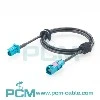
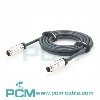
The salient features of a coaxial cable are that it consists of a center conductor, dielectric and outer shield arranged in a concentric, cylindrical construction.
At the next level of detail you want to know:
(1) The impedance.
(2) The loss and phase per unit length
(3) Nice to have: the frequency dependent per unit length R, L, G, C parameters.
Diving deeper still you want to know:
(1) What is the material and dimension of the centre conductor? Is it plated to help reduce skin effect? what is the thickness and material of the plating.
(2) What is the material of the dielectric and what are its dimensions? Is it treated — most likely foamed with air — to reduce effective Dk and reduce effective Df (air has a lower Dk and Df than any solid dielectric). What is the complex permitivity vs. frequency.
(3) What is the material and construction of the outer shield? It’s typically plated to resist corrosion but not to reduce loss as the surface area of the return path on a coax is much larger than the surface area of the centre conductor. What is the construction of the outer shield? Is it solid, woven, wound, or some combination of the above? Solid provides the best response at extremely high frequencies as its structure is continuous. Woven provides the greatest flexibility but impairs response in the 10s of GHz range as the short wavelengths can become sensitive to the standing wave components introduced by the non-isotropic nature of the return. Wound or a combination of wound surrounded by woven provide a much more isotopic return path providing for a smooth, notch free response into the high 10s of GHz and greatly reduced sensitivity to the movement of the cable albeit at some loss of flexibility.
(4) This relates greatly to (3): Is it classified as rigid (not suitable for or requiring great care and special equipment for bending)., is it semi-rigid (allowing some manual bending for initial positioning but not intended for continuous or frequent bending), or is it flexible (a relative term), meaning that it’s designed to permit a great deal of movement and repositioning, but even then it will be subject to a minimum bend radius below which its impedance and transmission characteristics will be impaired.
(5)If it’s a pre-terminated cable what style and grade of connectors (production, laboratory, metrology) does it provide?
(6)When buying multiple pre-assembled cables, what is the tolerance on length or phase matching at a specified frequency.
(7) What is its maximum power rating? Important for high power transmitter applications.
(8) What is its linearity. Even passive components like coax can introduce non-linearity at high power levels.
Eventually, with increasing frequency, you get to a point where even the best coax will not be able to meet the requirements for some combination of loss, transmission ripple, and power. At that point you must transition to using waveguides.